
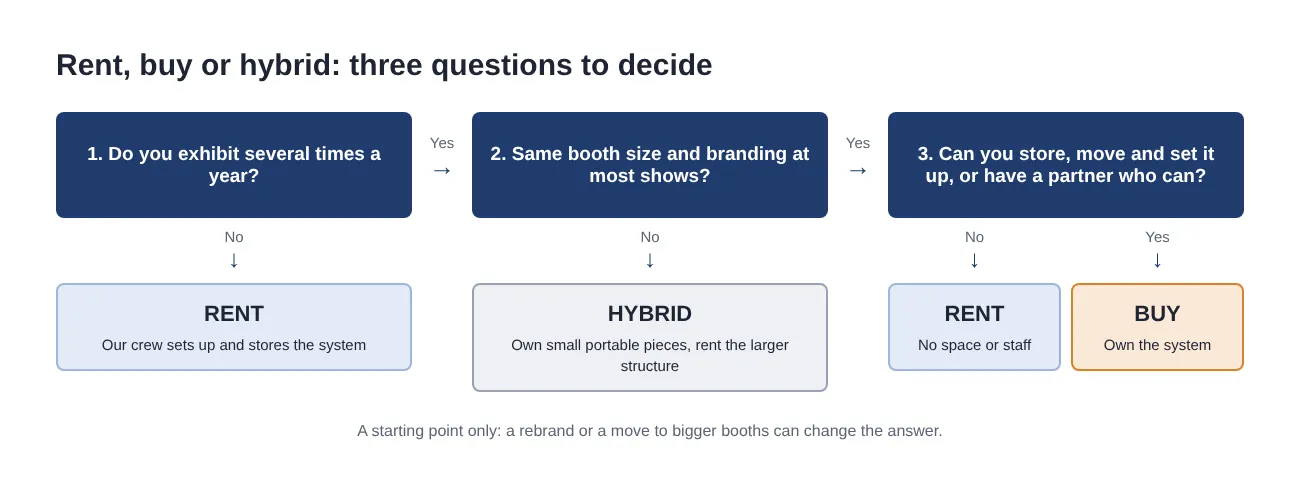
Whether to rent or buy exhibition setup systems depends mostly on how often you exhibit with the same set-up. Owning makes sense when you use one booth size and one look again and again, and you can store, move and build the kit. Renting makes sense when your shows, sizes or branding change, or when your team has no space or time to look after display systems. Many exhibitors land in between: they own small portable pieces and rent the larger structure.
In this article
- What decides whether you should rent or buy exhibition setup systems?
- What does owning display systems involve?
- What does display system rental include?
- Who handles what when you rent or buy?
- Worked example: two exhibitors, two different answers
- When does buying your display systems make sense?
- When does renting display systems make sense?
- Is there a middle way between renting and buying?
- What can renting and buying not do?
- Is buying or renting right for you?
- Common mistakes when deciding to rent or buy
- Further reading
- Frequently Asked Questions
- Sources cited
Key takeaways
- Our rental service covers logistics and packaging, installation and dismantling, and storage and maintenance of prints and systems (DSP).
- Owning suits frequent shows with the same booth size and branding; renting suits varied sizes, changing messages and occasional events (worked example below).
- Owned systems must still meet venue rules, such as Suntec Singapore’s minimum Class 2 flame-spread rating for materials (Suntec Singapore).
- An ATA Carnet lets goods be temporarily exported for exhibitions and fairs, then re-imported, which matters if you ship owned systems abroad (Singapore Customs).
- A hybrid often works well: own the small portable pieces and rent the larger structure per show.
What decides whether you should rent or buy exhibition setup systems?
Is it better to rent or buy a trade show booth? In practice, the question is about the backdrops, panels, counters and banners that fill your space. It depends on your calendar and your team. Eight practical factors usually settle it.
| Factor | Points towards buying | Points towards renting |
|---|---|---|
| How often you exhibit | Many events a year | One to three events a year |
| Booth size | Same size at most events | Different sizes at different shows |
| Storage space | Dry, clean space available all year | No spare room in the office or warehouse |
| Transport and handling | Kit is light and your team can move it | Large structure that needs a truck and crew |
| Set-up staff and time | Someone is trained and free to build it | Your team is busy preparing for the show itself |
| Maintenance and repairs | You can check, clean and fix parts | You want someone else to check every piece |
| Branding changes | Messages stay stable for years | New products, campaigns or a rebrand are likely |
| Venues and overseas events | Mostly the same local venues | Varied venues, or shows abroad |
If most of your answers sit on the right, renting is the safer choice. If most sit on the left, owning is worth a closer look.
What does owning display systems involve?
Trade show display ownership means you take on every task between shows, not just at them.
- Storage. Display systems need a dry, clean place all year. Panels scratch and fabric graphics crease if they are squeezed into an office corner.
- Transport and handling. Someone has to pack the kit, book a vehicle and load it to and from the venue for every show.
- Set-up and dismantling. Your staff build the set-up before opening and take it down after closing, often late at night.
- Maintenance and repairs. Clips go missing, poles bend and lights fail. Someone must check each piece before the next event.
- Graphics. New products, new campaigns or a rebrand mean new prints, even on a frame you already own.
Together, these tasks add up to a lot of staff hours, especially for a small marketing team. One client noted on our About Us page that his set-up was ready “within 6 hours” when our crew handled it. That is time his team could give to visitors instead.
What does display system rental include?
Display system rental in Singapore hands most of those tasks to a partner. Our rental services page sets out what that includes:
- Logistics and packaging, with support for local and overseas events and exhibitions.
- Installation and dismantling.
- Storage and maintenance of your prints and systems.
- Warehousing, with every print and system checked before and after each event.
Our portable display rental range in Singapore runs from roll-up banners and pop-up backdrops to system panels for upgrading a shell scheme booth. All of it is reusable and set up by our crew. Our product pages also state that customised printing is included with every system.
Who handles what when you rent or buy?
This table shows who carries each task and each risk when you rent or buy display systems.
| Task or risk | Buy | Rent from DSP |
|---|---|---|
| Storage between shows | Your space or a warehouse you arrange | Handled in our warehouse |
| Transport to the venue | You arrange it for every show | Logistics and packaging are part of the service |
| Set-up and dismantling | Your team or a crew you book | Our crew |
| Checks and repairs | Your responsibility | Every print and system checked before and after each event |
| Graphics changes | You arrange new prints | Customised printing included with every system |
| Space size changes | Limited to the system you own | Choose a system to suit each booth size |
| Same look every year | Yes, the same structure each time | Can look different at every show |
| Venue material rules | You confirm the kit still complies | Discuss the venue’s rules with us before the show |
Worked example: two exhibitors, two different answers
This is an illustrative example. The two exhibitors are invented to show how the factors work. They are not DSP clients.
Exhibitor A takes part in two trade fairs a year. One is a shell scheme booth that needs an upgrade with system panels. The other is a larger space-only booth with a different layout. The company launches new products every year, so its messages change at each show. Its office has no spare storage room, and its two-person marketing team also runs the company’s online channels.
Exhibitor B runs eight shopping mall roadshows a year. It uses the same 3m backdrop and one counter at every roadshow. Its branding has been stable for years. It has a storeroom, and a trained staff member sets up the backdrop at each site.
| Factor | Exhibitor A | Exhibitor B |
|---|---|---|
| How often | Two events a year | Eight events a year |
| Space size | Changes between shows | Same 3m backdrop every time |
| Storage | None available | Storeroom available |
| Transport and handling | Larger structure, needs a crew | Light kit, one person can move it |
| Set-up staff and time | Team busy with other work | Trained staff member |
| Branding changes | New messages each year | Stable branding |
| Points to | Rent | Buy |
Exhibitor A should rent. Owned systems would sit in storage it does not have for most of the year. They would also fit only one of the two spaces. Panel system rental in Singapore lets it pick Panel Systems configured to each booth size, with fresh graphics for each launch. Our crew handles set-up, so the marketing team can prepare for visitors instead.
Exhibitor B should buy. It uses the same backdrop eight times a year, has somewhere to keep it and has a person to build it. A Pop Up (Magnetic) display suits this pattern: assembly is tool-free, so you pull up the frame and attach the magnetic graphic panels. If the storeroom fills up later, Exhibitor B can still ask a partner to store the backdrop between roadshows.
When does buying your display systems make sense?
Buying tends to make sense in four situations:
- Frequent shows. You exhibit many times a year with the same set-up.
- Same space size. Your space is the same, or close to it, at most events.
- Stable branding. Your messages and visuals will stay the same for a few years.
- Portable systems. The kit is light, quick to build and easy to store. The ISO Frame bends up to 180 degrees, and its link system lets you shape the wall to fit different venues.
For exhibitors who want to own a system, we also offer customised portable display systems built around your brand. If you plan to build it yourself, read our guide on how to set up for a trade show in Singapore.
When does renting display systems make sense?
Trade show display rental in Singapore tends to make sense in five situations:
- Occasional shows. One to three events a year leave owned systems idle most of the time.
- Varied sizes. A shell scheme upgrade this quarter, a space-only booth the next. Modular panels can be connected and rearranged for each space.
- Changing messages. New launches or a rebrand mean new graphics anyway. Our guide to exhibition graphics printing explained covers the main graphic types.
- Overseas events. Shipping owned systems abroad adds paperwork. Singapore Customs explains that an ATA Carnet allows goods to be temporarily exported for exhibitions, fairs and similar events, then re-imported (Singapore Customs). Our rental service supports local and overseas events.
- No storage or set-up staff. If your team has neither space nor time, renting removes both tasks.
For many brands, renting is also the safer test. You learn which layout works before you commit to owning one. Our guide to what to look for in a display rental company covers how to choose a partner, and our article on exhibition logistics in Singapore explains the moving parts on show days. To see why renting suits many brands, read why renting display systems suits growing brands.
Is there a middle way between renting and buying?
Yes. Many exhibitors own the portable pieces they use at every event and rent the larger structure per show. A pull-up banner, a counter or a pop-up backdrop goes to roadshows, seminars and lobbies all year. The full display walls only appear at the big trade fairs, so display system rental covers those.
Ownership and storage can also be split. We provide warehousing for portable and modular systems, and check every print and system before and after each event. In the client reviews on our About Us page, one client says he could ask us “to store my pop-up booth for me to reuse at the next event”. You keep your own systems without giving up office space. If you are also weighing structure types, read modular vs custom exhibition displays.
What can renting and buying not do?
Neither option removes the venue’s rules. Suntec Singapore requires materials to be fire-retardant, and either non-combustible or rated at least Class 2 for flame spread (Suntec Singapore). Owned systems must still meet each venue’s rules, years after you buy them. Check the exhibitor manual for every show.
Buying cannot:
- Adapt a fixed structure to a very different booth size.
- Remove storage and maintenance work in quiet months.
- Make old graphics match a new brand without new prints.
Renting cannot:
- Guarantee the exact same structure at every show, years apart.
- Remove the need to approve artwork and plan logistics before each show.
Is buying or renting right for you?
Answer these five questions honestly:
- Will you exhibit many times a year with the same set-up?
- Will most of your spaces be the same size?
- Do you have suitable, dry storage space all year?
- Does someone on your team have time and training to build and dismantle the systems?
- Will your brand and messages stay stable for two to three years?
Mostly yes points to buying. Mostly no points to renting. Mixed answers usually point to the hybrid: own the portable pieces, rent the structure.
Common mistakes when deciding to rent or buy
- Looking only at the event days. Owned systems need storage, checks and handling all year.
- Leaving out staff time. Hours spent building a set-up are hours away from show preparation.
- Assuming storage is easy. Office corners fill up, and kit gets damaged.
- Ignoring graphics. New products or a rebrand mean new prints, even on an owned frame.
- Buying for a size you rarely book. A system that fits only one space sits idle.
- Forgetting venue rules. Older materials still have to meet each venue’s fire safety requirements.
- Forgetting overseas paperwork. Taking owned systems abroad needs planning with customs documents such as the ATA Carnet.
Further reading
- Exhibition logistics in Singapore
- Modular vs custom exhibition displays
- How to set up for a trade show in Singapore
- Exhibition graphics printing explained
Display Systems and Prints has supported exhibitors in Singapore since 2008, with more than 5,000 projects completed. We rent, customise and store portable display systems, so we can recommend renting, buying or a mix based on your calendar. Tell us your shows for the next year, your booth sizes and the systems you already own, and we will suggest the simplest route. Talk to our team
Frequently Asked Questions
Is it better to rent or buy exhibition setup systems in Singapore?
It depends on how often you exhibit with the same set-up. Buying suits frequent shows with the same booth size and stable branding, plus storage and staff to build the systems. Renting suits occasional shows, varied booth sizes, changing messages and teams without storage space. Many exhibitors choose a hybrid, owning small portable pieces and renting the larger structure for big trade fairs.
How often do I need to exhibit before buying makes sense?
There is no fixed number, because frequency is only one factor. Buying makes more sense the more often you reuse the same backdrop, panels and graphics in the same size of space. If you exhibit one to three times a year, or each show needs a different layout, owned systems may sit idle for most of the year. Check storage, staff time and branding plans before deciding.
What do people forget to plan for when they buy display systems?
The most forgotten tasks are storage, transport, repairs and staff time for set-up and dismantling. New graphics are also easy to miss when products or messages change. Owners must also confirm that their systems still meet each venue’s material rules, such as fire-retardant materials. List every task for a full year before comparing ownership with renting.
Can I buy a portable display system and still have someone store and set it up?
Yes. Display Systems and Prints provides warehousing for portable and modular systems, with every print and system checked before and after each event. Our crew can also handle installation and dismantling. This lets you own the system without using office space for storage or your team’s time for set-up. Talk to our team about combining storage and set-up.
Do owned display systems have to meet venue rules?
Yes. Owning a system does not exempt it from venue rules. Suntec Singapore, for example, requires materials to be fire-retardant, and either non-combustible or rated at least Class 2 for flame spread. Rules can differ between venues, so read the exhibitor manual for each show and confirm that older panels and graphics still comply before you ship them to site.
Should I rent or buy exhibition booth systems for an overseas trade fair?
For a one-off or occasional overseas show, renting is usually simpler. Shipping owned systems abroad means packing, freight and customs paperwork. Singapore Customs explains that an ATA Carnet allows goods to be temporarily exported for exhibitions and fairs, then re-imported. Display Systems and Prints supports local and overseas events through its rental service, so ask us which route suits your show.