

We suggest planning trade show booth setup in Singapore as a 12-week countdown, from booking your space to clearing your waste. You choose shell scheme or space only, log manual deadlines, approve the design, submit plans, check fire rules, order power, print, deliver and build. Venue rules are strict: at Suntec Singapore, booth materials must meet a Class 2 flame spread rating and only accredited electricians may do electrical work. Your organiser’s manual sets the exact dates, so build your plan backwards from them.
In this article
- What are the steps to set up a trade show booth in Singapore?
- Shell scheme or space only: which setup are you running?
- What do Singapore venues require before you build?
- What does a 3m x 3m shell scheme timeline look like?
- What a setup timeline can and cannot do
- Is DIY or full-service setup right for you?
- Common mistakes in trade show booth setup
- Further reading
- Frequently Asked Questions
- Sources cited
Key takeaways
- Booths and structures 4 metres and above at Suntec Singapore need technical plans at a scale no less than 1:50 (Suntec Singapore).
- Booth and ceiling materials at Suntec Singapore must be non-combustible or have a minimum Class 2 surface flame spread rating (Suntec Singapore).
- On Suntec’s Levels 4 and 6, the venue powers only its own AV and F&B items, so organisers must engage an appointed electrician (Suntec Singapore).
- Suntec only accepts deliveries during the licensed period, and vehicles may use loading bays for 20 minutes each (Suntec Singapore).
- DSP rental covers logistics and packaging, installation and dismantling, and storage of your prints and systems (DSP).
What are the steps to set up a trade show booth in Singapore?
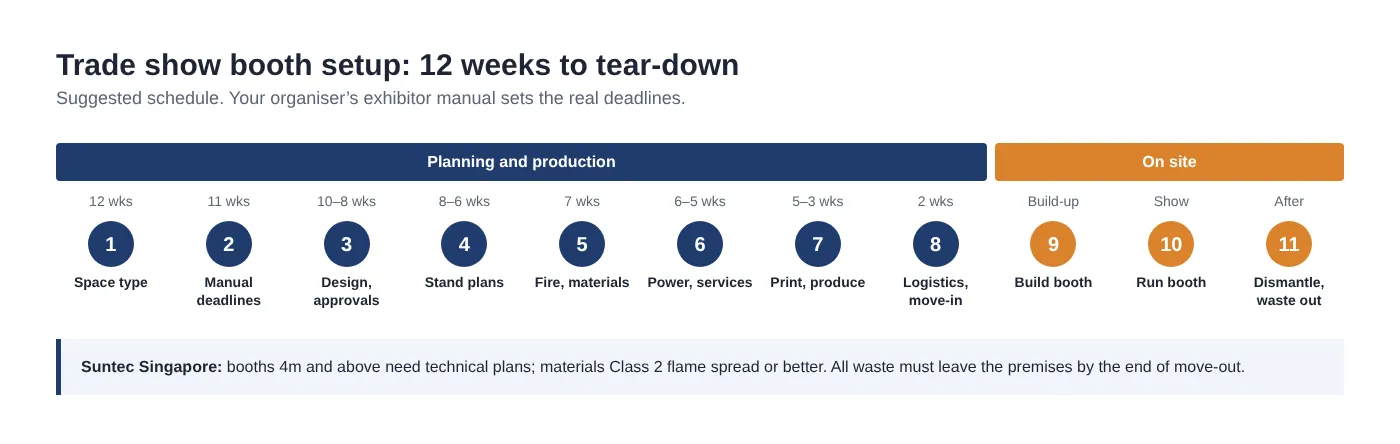
There are eleven steps, and each one has a natural place on the calendar. The weeks below are a working schedule we suggest for a standard booth. They are not venue rules. Your organiser’s exhibitor manual sets the real deadlines, and those always win.
If your show is less than 12 weeks away, compress the early steps rather than skipping them. Stand plans, power orders and artwork sign-off are the hardest steps to rush.
| When (before show day) | Step | What to do | Rule or reference |
|---|---|---|---|
| 12 weeks | 1. Choose your space type | Decide shell scheme or space only when you book | Organiser’s booking form |
| 11 weeks | 2. Log manual deadlines | List every form, order and submission date in one calendar | Organiser’s exhibitor manual |
| 10 to 8 weeks | 3. Design and approvals | Agree the layout, products and messages internally | Your own sign-off process |
| 8 to 6 weeks | 4. Submit stand plans | Booths 4m and above need technical plans at Suntec | Suntec Singapore |
| 7 weeks | 5. Check fire safety and materials | Confirm Class 2 flame spread or non-combustible materials | Suntec Singapore |
| 6 to 5 weeks | 6. Order electrics and services | Order power through the organiser’s power order form; apply for rigging | Suntec Singapore |
| 5 to 3 weeks | 7. Print and produce | Final artwork to the printer, then pre-fit graphics to frames | Your printer’s schedule |
| 2 weeks | 8. Plan logistics and move-in | Deliver within the licensed period; allow 20 minutes per vehicle in the bay | Suntec Singapore |
| Build-up day(s) | 9. Build the booth | Build only inside your licence area, keep fire equipment clear | Suntec Singapore |
| Show days | 10. Run the booth | Keep displays out of aisles and away from exits | Suntec Singapore |
| Dismantling | 11. Dismantle and remove waste | Pack, remove all waste, leave nothing after move-out | Suntec Singapore |
For what happens inside step 8 in more depth, our guide to choosing a reliable logistics partner covers packing, transport and overseas shipments.
Shell scheme or space only: which setup are you running?
Your space type decides how much of Table 1 you own. A shell scheme is a ready-made booth from the organiser, usually with walls and a fascia. Space only is bare floor, and you or your contractor build everything on it.
Shell scheme exhibitors skip most structural work. Their effort goes into graphics, furniture and power. Space only exhibitors take on drawings, approvals, materials evidence and a longer build.
| Setup task | Shell scheme | Space only |
|---|---|---|
| Structure | Provided by the organiser | Designed and built by your contractor |
| Stand plan submission | Any forms the organiser’s manual asks for | Technical plans if 4m and above at Suntec |
| Fire-rated materials | Mainly your own add-ons and graphics | Every wall, floor and ceiling element |
| Electrical | Order through the organiser or venue | Appointed electrician, plus your own layout |
| Graphics | Panels sized to the shell walls | Custom sizes for the whole structure |
A plain shell scheme does not have to look plain. DSP offers shell scheme graphics printed on kapaline boards with matte or glossy lamination, sized to your panel dimensions. Shell Clad graphics attach to the shell with clips and Velcro, and each panel is individually printed and rollable. For a more complete upgrade, our shell scheme solutions combine components into one branded unit. These event display solutions in Singapore work on any organiser shell.
What do Singapore venues require before you build?
Each venue publishes its own rules, and each organiser adds more. Suntec Singapore publishes detailed rules in its exhibitor knowledge base. Singapore EXPO publishes hall specifications, and show-specific rules arrive in the organiser’s manual.
| Topic | Rule | Source |
|---|---|---|
| Building area | Booths must be built within the licence area only | Suntec Singapore |
| Fire equipment | Keep at least 1.5 metres clear of hose reels, alarm call points and extinguishers | Suntec Singapore |
| Tall structures | 4 metres and above need technical plans, scale no less than 1:50 | Suntec Singapore |
| Double-storey | Needs a PE certificate, SCDF compliance and BCA permit approval | Suntec Singapore |
| Booth ceilings | Need a sprinkler or automatic extinguisher for every 12 sqm covered | Suntec Singapore |
| Materials | Non-combustible, or minimum Class 2 surface flame spread rating | Suntec Singapore |
| Working at height | Structures over 3 metres need a working at heights permit | Suntec Singapore |
| Electrical | Only licensed electrical workers on Suntec’s accredited list may do electrical work | Suntec Singapore |
| Rigging | Banner hanging and rigging need prior approval | Suntec Singapore |
| Aisles | Minimum 2.5 metres for trade events, 3.0 metres for consumer events | Suntec Singapore |
| Hall ceilings | Halls 1 to 6: 10 to 16m; Halls 7 to 10: 8 to 10m | Singapore EXPO |
| Atrium events | Booth height capped at 3 metres under an indoor Temporary Change of Use permit | SCDF |
Two more Suntec rules are easy to miss. First, Suntec’s Level 4 exhibition halls have no carpet, so plan flooring if you want it. Second, Suntec runs skip deliveries between 23:59 and 05:00 unless approved in advance, and all waste must leave before move-out ends.
If you are running a roadshow in a mall atrium rather than a hall, SCDF’s indoor conditions apply. Rows of booths may not exceed 15 metres long and 6 metres wide, with passageways of at least 1.2 metres between rows.
What does a 3m x 3m shell scheme timeline look like?
Here is an illustrative timeline for a 3m x 3m shell scheme booth at a trade event in a Suntec Level 4 hall. The weeks are our suggested schedule. The rules are Suntec’s published requirements.
The booth covers 9 sqm. It stays at the standard shell height, has no ceiling, and uses printed panels, a counter and one screen.
| When | Action | Why it matters |
|---|---|---|
| Week 12 | Book a shell scheme booth; confirm fascia name | Avoids drawings and structural approvals |
| Week 11 | Log manual deadlines for power, furniture and fascia | Late orders can miss the cut-off |
| Week 9 | Approve layout: back wall graphic, side panels, counter | Fixes graphic sizes before printing |
| Week 7 | Confirm no ceiling and no structure over 3 metres | No sprinkler or working at heights permit needed |
| Week 6 | Order power through the organiser’s power order form | The venue powers only its own items in Level 4 and 6 halls |
| Week 4 | Final artwork to the printer | Leaves time for a proof and one correction |
| Week 3 | Graphics printed; test-fit panels and counter | Catches size errors before move-in |
| Week 2 | Confirm delivery timing and crew | Deliveries only in the licensed period; 20 minutes per vehicle in the bay |
| Build-up day | Install graphics, counter and screen; keep 1.5m clear of fire equipment | Booth is ready before doors open |
| Show days | Keep everything inside the 9 sqm area | Overflow into aisles is not permitted |
| Dismantling | Remove panels, pack for storage, clear all waste | Nothing may remain after move-out |
Notice what the example avoids. Keeping the booth uncovered and below 3 metres removes two permits. Renting portable exhibition systems in Singapore also shortens build-up. DSP’s magnetic pop-up frames assemble without tools.
What a setup timeline can and cannot do
A dated plan is powerful, but it has limits. Be clear about both before you rely on it.
What it can do:
- Turn a long exhibitor manual into a short list of owned tasks.
- Show the gaps where one late step will push the next.
- Give your printer, electrician and installer fixed dates to work to.
What it cannot do:
- Replace the organiser’s deadlines. Their manual always overrides any general schedule.
- Guarantee approvals. Suntec advises case by case whether a professional engineer’s endorsement is needed.
- Cover every venue equally. Rules differ by venue. Always check the venue’s rules and the show manual.
- Fix a design that breaks the rules. A 4-metre structure or a covered booth adds steps no schedule can remove.
Is DIY or full-service setup right for you?
Some exhibitors manage every step themselves. Others hand the whole job to one team. The right answer depends on size, experience and staff time.
| Your situation | DIY setup | Full-service setup |
|---|---|---|
| Booth type | Small shell scheme with portable displays | Space only, custom build or several booths |
| Experience | You have exhibited at this venue before | First show, or a new venue |
| Staff time | Someone can own the timeline for 12 weeks | Your team is busy running the business |
| Overseas | Local show only | Overseas exhibitors or shipments |
| Risk tolerance | You can absorb a late graphic or missed slot | A missed slot would put the show at risk |
How does a vendor manage a trade show booth from start to finish? One team owns every row of Table 1. A total exhibition solutions provider in Singapore handles design, printing, logistics, installation and dismantling under one plan. DSP’s event project management services provide the manpower and logistics for local and overseas events. You can also read how full-cycle event project management works for retail brands.
Unsure whether to own your booth system at all? Our guide to renting or buying an exhibition booth compares the two.
Common mistakes in trade show booth setup
- Reading the manual too late. Power, furniture and fascia orders have cut-off dates. Log them in week 11, not week 3.
- Designing before checking height and ceiling rules. At Suntec, 4 metres triggers technical plans and a ceiling triggers sprinklers.
- Assuming any electrician can connect power. Only licensed electrical workers on Suntec’s accredited list may do electrical work there.
- Sending artwork without a test fit. A panel that is even slightly too wide will not sit in the frame.
- Arriving outside the licensed period. Suntec declines vehicles that arrive before or after it.
- Blocking fire equipment. Keep 1.5 metres clear of hose reels, alarm points and extinguishers.
- Forgetting the waste. All waste must leave the premises by the end of move-out.
Once the booth is built, the next job is filling it. Our article on ways to attract visitors to your booth picks up where this one ends.
Further reading
- Exhibition logistics services in Singapore: what logistics covers, from customs to teardown.
- Choosing a reliable logistics partner: venue access, shipping and partner checklists.
- Exhibition booth printing explained: fabric, SEG, vinyl and rigid graphics.
- Display rental services: systems for rent, with set-up, logistics and warehousing.
- Printing and installation: large format printing and in-house fabrication.
DSP has completed more than 5,000 projects since 2008, with rental, printing, installation and project management under one roof. If you want exhibition marketing solutions in Singapore that follow your timeline from booking to tear-down, tell us your show date and booth size. We reply within one working day. Talk to our team
Frequently Asked Questions
How far ahead should I start planning a trade show booth in Singapore?
We suggest starting about 12 weeks before show day. That leaves time to choose your space type, log manual deadlines, approve the design, order power and print graphics. A space only booth with technical plans needs more time. Always check the organiser’s exhibitor manual, because its deadlines override any general schedule and late orders can miss the cut-off.
Do I need to submit drawings for a shell scheme booth?
Usually not structural drawings, because the organiser provides the shell scheme structure. Fill in whatever forms the exhibitor manual lists. Space only booths are different. At Suntec Singapore, structures and booths 4 metres and above need technical plans at a scale no less than 1:50. Double-storey booths need a professional engineer’s certificate.
What fire safety rules apply to booth materials in Singapore?
At Suntec Singapore, booth and ceiling materials must be non-combustible or have a minimum Class 2 surface flame spread rating. Recognised test reports must support this. Booths with ceilings need a sprinkler or automatic extinguisher for every 12 sqm of covered area. You must also keep 1.5 metres clear of fire hose reels, alarm call points and extinguishers.
Can I do the electrical work on my booth myself?
No. At Suntec Singapore, only licensed electrical workers on the venue’s accredited list may carry out electrical work. On Levels 4 and 6, the venue powers only its own AV and F&B items, so organisers must engage an appointed electrician. High power needs may require a power turn-on, which is ordered through the Suntec Singapore Marketplace. We suggest placing this order five to six weeks out.
What happens to booth waste after the show?
You must clear it before move-out ends. Suntec Singapore states that all waste must be removed safely and securely and must not remain on the premises after move-out. Skip deliveries and changes run between 23:59 and 05:00 daily, unless approved in advance. Hazardous or toxic waste may not go into drains or general waste.
How does a vendor manage a trade show booth from start to finish?
A full-service vendor owns every step, from design and printing to logistics, installation, dismantling and storage. DSP’s rental service covers logistics and packaging, installation and dismantling, and storage and maintenance of prints and systems. Its project management team provides manpower and logistics for local and overseas events, so you deal with one team instead of several suppliers.