
Exhibition booth printing uses four main material families: printed fabric, SEG tension fabric, vinyl and other flexible films, and rigid boards. Fabric is usually dye-sublimated, a process that needs polyester. SEG graphics are printed fabric with a silicone edge that pushes into a frame channel. Vinyl suits roll-up banners and decals, and rigid boards suit shell scheme panels and posters. The right choice depends on the display system, the venue’s fire rules and how often you will reuse the graphic.
In this article
- What type of printing is used for exhibition displays?
- How do fabric, SEG, vinyl and rigid graphics compare?
- Which print suits which DSP display?
- What does a worked artwork example look like?
- What artwork files do printers need?
- What do Singapore venues require of fabric and board?
- How long do booth graphics last, and can you reuse them?
- What can each print type do, and what can it not do?
- Is fabric, vinyl or rigid printing right for you?
- What do Display Systems and Prints’ printing services cover?
- Common mistakes
- Further reading
- Frequently Asked Questions
- Sources cited
Key takeaways
- Dye-sublimation needs polyester fabric, so choose the fabric before the artwork.
- SEG graphics carry silicone beading on one or more edges, which pushes into an extrusion channel for a seamless finish (PRINTING United Alliance).
- Suntec Singapore requires booth materials to be non-combustible or rated at least Class 2 for surface flame spread (Suntec Singapore).
- PDF/X-1a, the print file format defined in ISO 15930-1, is built for complete CMYK data with fonts and images embedded (Library of Congress).
- Customised printing is included with every DSP display system, and DSP’s exhibition printing and installation services take graphics from artwork to installation (DSP).
What type of printing is used for exhibition displays?
Most exhibition booth printing falls into four groups, plus backlit fabric for lightboxes.
Dye-sublimated fabric. Dye-sublimation uses heat to set dye into polyester fabric. It works best on white or light fabric. DSP’s TenFab system uses fabric sublimation prints on an aluminium frame.
SEG tension fabric. SEG stands for silicone edge graphic. It is a printed fabric graphic with silicone beading attached to one or more edges. The beading pushes into a channel in the frame for a seamless display (PRINTING United Alliance). DSP’s Pop Up (SEG/Velcro) Fabric and Panel Up (SEG) Fabric systems both use this approach.
Vinyl and flexible films. Large format printing covers vinyl, banner material and film. DSP prints banners, decals, floor graphics, window displays and wall murals.
Rigid boards. Graphics are printed onto, or mounted onto, a stiff board. DSP prints shell scheme posters and murals on kapaline boards, with a matte or glossy lamination. Its printing range also covers acrylic.
Backlit fabric. A lightbox uses a fabric graphic lit from behind, so it stays bright whatever the hall lighting (DSP). It is a fabric print, but it is made for light to pass through.
How do fabric, SEG, vinyl and rigid graphics compare?
| Print type | How it fits the frame | Main strengths | Watch out for |
|---|---|---|---|
| Dye-sublimated fabric | Stretched, zipped or attached with Velcro | Folds for transport, smooth finish (DSP) | Needs polyester fabric |
| SEG tension fabric | Silicone edge pushed into a channel | Seamless, taut surface (PRINTING United Alliance) | Must be made to the exact frame size |
| Vinyl and film | Rolled into a base, hung or applied | Roll-ups, decals, floor and window graphics (DSP) | Roll-up mechanisms can wear with heavy use (DSP) |
| Rigid board (kapaline, foam board, acrylic) | Fixed to panels or framed | Holds fine detail well (DSP) | Bulkier to store; foam is limited at Suntec |
| Backlit fabric | Fitted into a lit frame | Bright in dim halls (DSP) | Needs power at the stand |
Which print suits which DSP display?
Customised printing is included with every DSP system. The frame sets the graphic type, so start with the display.
Pop Up (Magnetic). You pull up the frame and attach magnetic graphic panels. It can be curved or straight, with a choice of panel count and height. DSP also offers magnetic pop up display rental in Singapore. The Pop Up (Magnetic) display page shows the options. Artwork must allow for the joins between panels.
Pop Up (SEG/Velcro) Fabric. The fabric graphic expands as you unfold the frame. It comes in 2, 3 or 4 panel sizes, with built-in LED ladder lights. See the Pop Up (SEG/Velcro) Fabric display.
Panel Systems. Modular panels connect and rearrange to suit the space. DSP rents panel systems sized to your booth. The Panel Systems page lists the uses.
Maxpoles. The backdrop is compatible with vinyl, muslin and paper. See Maxpoles backdrops.
Roll-up banners. The graphic retracts into the base. Double-sided and outdoor-rated options are available. DSP lists seven roll-up and pull-up banner sizes, from 600 mm x 1700 mm to 2400 mm x 2000 mm.
Lightbox. The Lightbox system takes a backlit graphic and can be built up to 3 m tall and 12 m long.
Shell scheme graphics. These are posters or murals on kapaline boards, sized to your exhibition panels. See Shell Scheme Graphics. Shell Clad is the fabric alternative: each panel is printed separately, rolls up and attaches with Velcro.
ISO Frame. The frame bends up to 180 degrees and links with the Flexi-Wave system. Curved walls need artwork that reads well around a bend.
| DSP display | Graphic as described on DSP’s site | Typical use |
|---|---|---|
| Pop Up (Magnetic) | Magnetic graphic panels | Curved or straight backdrop |
| Pop Up (SEG/Velcro) Fabric | Fabric graphic, SEG channel bars | Lit fabric backdrop, 2 to 4 panels |
| Panel Systems | Customisable panel graphics | Walls sized to the booth |
| Maxpoles (Backdrops) | Vinyl, muslin or paper backdrop | Event and photo backdrops |
| Roll-up banners | Retractable banner, seven sizes | Extra messages, entrances |
| Lightbox | Backlit fabric graphic | Lit feature wall |
| Shell Scheme Graphics | Kapaline board, matte or gloss lamination | Shell scheme booth walls |
| TenFab | Elastic fabric sublimation print | Frequent use, 2.5 m to 6 m long |
What does a worked artwork example look like?
This example uses DSP’s stated roll-up sizes. The resolution and bleed figures are illustrative; your printer’s template sets the real ones.
Step 1: compare the shapes. An 850 mm x 2000 mm banner has a width-to-height ratio of 0.425. A 1000 mm x 2000 mm banner has a ratio of 0.5. The two shapes are different, so one file cannot fill both.
Step 2: see what happens if you reuse the file. Placed at full height on the 1000 mm banner, the 850 mm artwork leaves 150 mm empty. That is 75 mm per side. Scaled up to fill the width instead, it grows by 1000 ÷ 850, or about 1.18 times. The height becomes about 2353 mm, so roughly 353 mm would be cropped.
Step 3: work out the pixels. Suppose, for illustration, your printer asks for 100 pixels per inch at full size. 850 mm is 33.5 inches, so you need about 3,350 pixels across. 2000 mm is 78.7 inches, so you need about 7,870 pixels in height.
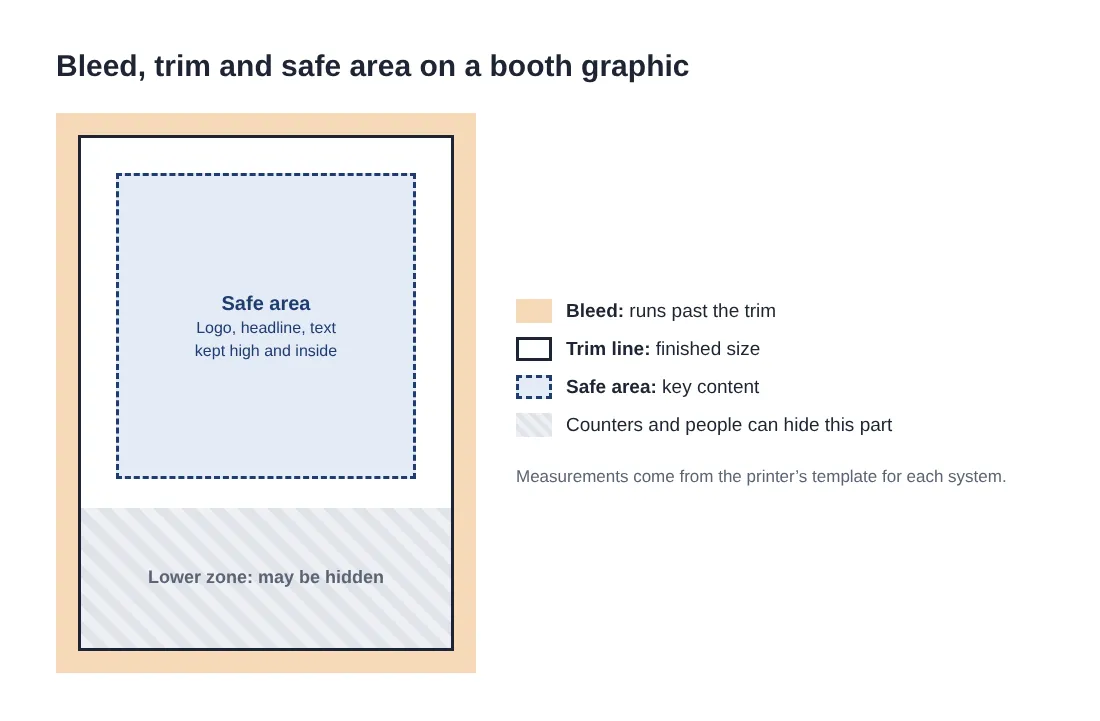
Step 4: add the bleed. Suppose the template asks for 5 mm of bleed on every side. The document becomes 860 mm x 2010 mm. Background colour and images run to that outer edge, and text stays well inside it.
Ask for the template for the exact size first, then design.
What artwork files do printers need?
Get the exact template for each system before designing. Use vector logos and text, which stay sharp at any size. Use images large enough for the final print size, and ask the printer to check them. Approve a proof before production, checking colours, spelling and contact details.
Colour mode matters too. Screens show RGB colour, while print presses work in CMYK. The PDF/X family is the standard set of print-ready PDF formats. PDF/X-1a, specified in ISO 15930-1, is designed for complete exchange of CMYK data (Library of Congress). In PDF/X files, fonts must be embedded and images must be in the file (Library of Congress).
Bleed and resolution figures vary between printers and systems, so use the figures in the template DSP sends for your display.
What do Singapore venues require of fabric and board?
For exhibition printing in Singapore, venue rules come first. Suntec Singapore says all booth materials must be fire retardant under prevailing fire safety regulations. Materials for booths and ceilings must be non-combustible or have at least a Class 2 surface flame spread rating. That rating must be supported by internationally recognised test reports or certificates (Suntec Singapore).
Fabric has its own rule there. Overhead fabrics, such as covers, canopies, curtains and draperies, must be permeable to water and rated at least Class 2 (Suntec Singapore). Suntec also says combustible materials such as plastics, paper and foam should be limited. They should not be used for general wall covering (Suntec Singapore). That matters if you planned a whole wall in foam board.
What does Class 2 mean? SCDF’s Fire Code defines it as a surface of low flame spread. In the test, flame spread must not exceed 215 mm in the first 1.5 minutes, and the final spread must not exceed 455 mm (SCDF). The test is BS 476 Part 7.
Other venues set their own rules. Check the manual for your show, and ask your printer for the fire test certificate of each material.
How long do booth graphics last, and can you reuse them?
Fabric graphics give a smooth, wrinkle-resistant finish and fold for transport, according to DSP. Rigid panels hold fine detail but take more space. Shell Clad panels are printed separately and roll up, so they travel without damage. Panel Up (SEG) Fabric lets you switch artwork between campaigns. TenFab is designed for frequent use and minimal maintenance.
DSP’s rental, storage and maintenance services include warehousing for portable and modular systems. All prints and systems are checked before and after each event. A good habit is to keep evergreen branding on the main backdrop. Put dated offers on a roll-up or a small panel that is easy to replace.
What can each print type do, and what can it not do?
| Print type | What it can do | What it cannot do |
|---|---|---|
| Dye-sublimated fabric | Fold for transport; give a smooth finish | Print onto cotton or dark fabric |
| SEG fabric | Give a seamless, taut wall | Fit a frame it was not sized for |
| Vinyl and film | Cover roll-ups, decals, floors and windows | Avoid wear on a heavily used roll-up (DSP) |
| Rigid board | Show fine detail, take lamination | Cover whole walls in foam at Suntec |
| Backlit fabric | Stay bright in dim halls | Work without power at the stand |
Is fabric, vinyl or rigid printing right for you?
- You exhibit several times a year and want one backdrop: choose a fabric or SEG system. It folds or packs small and takes new prints later.
- You need a fast extra message: choose a vinyl roll-up. Our comparison of pop-up displays compared with roll-up banners covers when each works.
- You have a shell scheme booth: choose Shell Scheme Graphics on board, or Shell Clad fabric if you need to roll and reuse.
- Your hall is dim or your stand is crowded: choose a lightbox with a backlit fabric graphic.
- You need a non-standard shape: talk to DSP about a custom display, and plan artwork after the layout is fixed.
If you are still choosing the displays themselves, start with the five displays most booths need.
What do Display Systems and Prints’ printing services cover?
If you want one partner for the graphics as well as the displays, DSP’s printing and installation services cover the full range. These are printing services for exhibitions, events and retail spaces. DSP lists posters and canvas, banners and backdrops, decals and pillar wraps, and hoarding and window displays. It also lists wall murals and lightboxes, acrylic work, escalator graphics and signage, exhibition and event graphics, and floor graphics. DSP installs advertising in offices, shop fronts, malls, car park gantries and outdoor sites.
Customised printing is included with every DSP display system. Shell Scheme Graphics are sized to your exhibition panels. DSP has in-house designers, fabricators and installers, which gives it control over quality and timing.
What does that mean for you? You deal with one team from artwork to installed graphics. Your prints are made to fit the DSP system they go on, so sizes and fittings match. DSP’s installers then fit the graphics on site. If you are comparing exhibition printing services in Singapore, this is the outcome to look for.
| What DSP prints | Where it is used |
|---|---|
| Banners and backdrops | Exhibition booths and events |
| Exhibition and event graphics | Booth walls and event spaces |
| Shell Scheme Graphics | Shell scheme booth panels |
| Wall murals and lightboxes | Walls and lit feature walls |
| Floor graphics | Floors at booths and venues |
| Hoarding and window displays | Shop fronts and hoardings |
| Decals and pillar wraps | Pillars, glass and flat surfaces |
| Escalator graphics and signage | Malls and public buildings |
| Indoor and outdoor advertising | Offices, malls, car park gantries and outdoor sites |
Common mistakes
- Low-resolution artwork. A web image enlarged to two metres looks blurry. Supply images large enough for the print size.
- Wrong colour mode. RGB files can shift colour when printed. Supply print files set up for CMYK, such as PDF/X-1a.
- Missing bleed. Without bleed, a thin white edge can appear after trimming. Use the bleed in the template.
- Text across a fold or join. On multi-panel walls, colours must match across panels and seams must line up (DSP). Keep text and faces away from the joins.
- Key messages too low. Counters and people often hide the lower part of a backdrop (DSP).
- No fire certificate. Suntec asks for test reports or certificates for booth materials (Suntec Singapore).
Further reading
- See what DSP prints and installs with its exhibition printing and installation services.
- Plan the build day with our step-by-step booth setup guide.
Display Systems and Prints has supplied, printed and installed displays in Singapore since 2008, with more than 5,000 projects completed. Its in-house designers, fabricators and installers keep control of quality and timing. Our printing and installation team can take your graphics from artwork to installed booth. Tell us your display, booth size and show date, and we will reply within one working day. Talk to our team
Frequently Asked Questions
What type of printing is used for exhibition displays?
Exhibition displays mostly use dye-sublimated fabric, SEG tension fabric, vinyl printed on large-format inkjet printers, and rigid boards. Fabric suits pop-up and tension backdrops, vinyl suits roll-up banners and decals, and rigid board suits shell scheme panels and posters. Lightboxes use a backlit fabric graphic. Display Systems and Prints includes customised printing with every display system it supplies.
What is an SEG graphic?
An SEG graphic is a printed fabric graphic with silicone beading attached to one or more edges. The beading pushes into a channel in the frame for a seamless display. Because it must fit the channel exactly, an SEG graphic is made to the precise size of the frame it will go into.
What do Display Systems and Prints’ printing services include?
Display Systems and Prints prints and installs large format graphics for exhibitions, events and retail spaces. Its range covers banners and backdrops, decals and pillar wraps, window displays, wall murals, lightboxes, floor graphics, acrylic work and exhibition graphics. Customised printing comes with every display system it supplies. Its in-house designers, fabricators and installers handle the work, so one team takes your graphics from artwork to installation.
What colour mode should exhibition artwork be in?
Print artwork should be prepared for CMYK, the colour model used in printing, rather than RGB, which is used on screens. A common print-ready format is PDF/X-1a, defined in ISO 15930-1 for complete CMYK data exchange. PDF/X files must embed fonts and include all images. Always follow the colour settings in the template your printer supplies.
Do booth graphics in Singapore need to be fire retardant?
Yes, at Suntec Singapore all booth materials must be fire retardant. They must be non-combustible or rated at least Class 2 for surface flame spread, backed by recognised test reports or certificates. Overhead fabrics must also be water permeable and Class 2. Other venues publish their own exhibitor manuals, so check the rules for your specific show.
Can I reuse my booth graphics at the next show?
Yes, if the material and storage allow it. Fabric graphics fold for transport, and systems such as Panel Up (SEG) Fabric let you swap artwork between campaigns. Display Systems and Prints offers warehousing for portable and modular systems and checks all prints and systems before and after each event, which helps graphics last for several shows.