
A modular booth reuses a frame system and changes mainly the layout and graphics. A custom booth is built to your own design, so you get more freedom but longer lead times. For one-off or occasional shows, modular is usually the faster and simpler route. If you exhibit often at a consistent footprint, or need structures a system cannot form, custom or hybrid builds start to make sense.
In this article
- What is the difference between a modular and a custom exhibition booth?
- How do modular and custom booths compare side by side?
- How often you exhibit: why does it change the answer?
- Does booth size favour modular or custom?
- Which Singapore venue rules affect each type of stand?
- Worked example: one show a year or four?
- What can each type of booth not do?
- Which is better, modular or custom booth for your trade show?
- Common mistakes when choosing a booth type
- Further reading
- Frequently Asked Questions
- Sources cited
Key takeaways
- Modular systems use reusable frames, so customisation focuses on layout and graphics. Frames can be reconfigured as straight, L or U shapes (DSP).
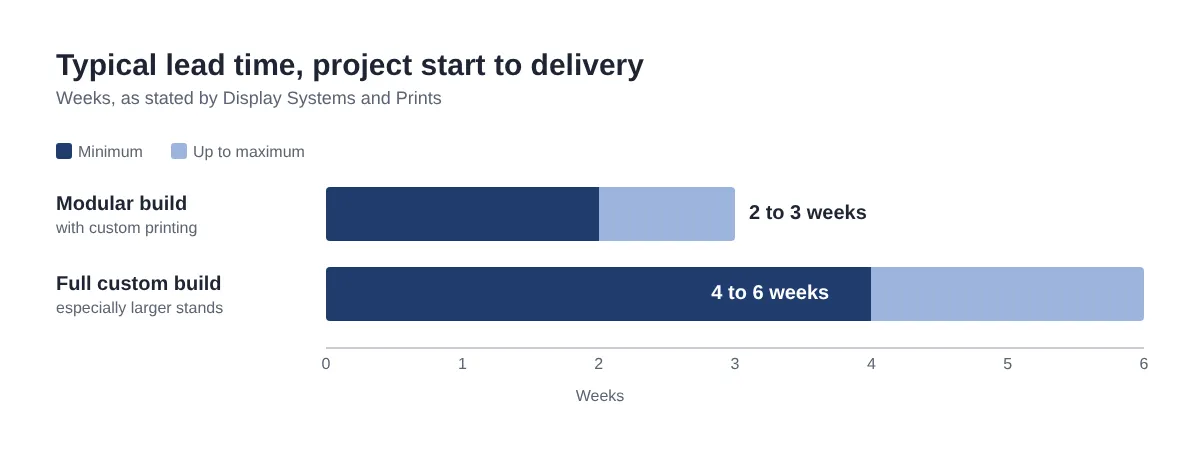
- Standard modular builds with custom printing usually take 2 to 3 weeks from project start to delivery. Full custom builds take about 4 to 6 weeks (DSP).
- At Suntec Singapore, structures of 4 metres and above need technical plans. Double-storey booths need a professional engineer’s certificate and BCA permit approval (Suntec Singapore).
- Booth materials at Suntec Singapore must be fire-retardant: non-combustible, or with at least a Class 2 surface flame spread rating (Suntec Singapore).
- Under an SCDF Temporary Change of Use permit, booths must not exceed 3 metres (SCDF).
What is the difference between a modular and a custom exhibition booth?
A modular booth, also called system-built, uses an existing frame or panel system. DSP describes portable systems as reusable modular frames, where “the main customisation is in layout and graphics”. Popular modular display systems in Singapore include panel systems, which let you connect and rearrange panels into different configurations. Customised printing is included with every system.
A custom booth, also called bespoke or built, is designed and fabricated for your brand and space. DSP notes that fully built custom booths use timber, paint and joinery. They look impressive but are typically used once. Many custom builds use aluminium framing, composite panels and printed graphics, chosen for repeated assembly.
A hybrid booth mixes the two. DSP notes that bespoke does not always mean built from scratch. Fabrication can mean a fully custom build or custom finishes on a modular base. Many bespoke exhibition displays in Singapore sit in this middle ground.
How do modular and custom booths compare side by side?
The table below is based on DSP’s own process and systems.
| Factor | Modular (system-built) | Custom (bespoke built) |
|---|---|---|
| Lead time | About 2 to 3 weeks with custom printing | About 4 to 6 weeks, especially larger stands |
| Reuse | Frames reused across shows | Typically used once, unless parts are designed for reuse |
| Flexibility | Reconfigure as straight, L or U shapes; add panels for bigger booths | Built to one footprint and layout |
| Design freedom | Shape set by the frame system | Built to your specifications |
| Set-up | Small pop-ups suit self set-up; larger layouts use a crew | Installed by a crew, about 1 day on site |
| Storage | Frames and prints can be stored between events | Depends on the size of the components kept |
| Waste | Same frames return for the next show | Timber and joinery builds are typically used once |
DSP provides warehousing and checks prints and systems before and after each event. That applies to both routes.
How often you exhibit: why does it change the answer?
How often you exhibit is one of the main factors. DSP’s guide to choosing the right event display solution recommends rental systems for infrequent exhibitors and one-off events. They avoid storage and maintenance. The same guide recommends custom fabrication for brands that exhibit regularly at a consistent footprint, because reuse makes the build pay off.
The words “consistent footprint” matter. A custom booth built for a 6m x 4m space will not shrink neatly into a 3m x 3m space. A modular kit can, because you add or remove panels. If your show calendar mixes booth sizes, modular keeps more options open.
Weighing ownership as well as build type? Our companion article on whether to rent or buy an exhibition booth covers that decision.
Does booth size favour modular or custom?
Small booths often suit portable booth systems in Singapore, which you can carry and reconfigure. DSP notes that a 3m x 3m modular layout can often be expanded for a larger or corner booth with extra panels. If your space comes as a shell scheme, DSP’s shell scheme solutions let you attach custom-printed graphic panels.
Size alone does not decide it, though. What you need inside the space matters more. Three DSP projects show the range:
- Zimmer Biomet, 4m x 3m. The Zimmer Biomet compact booth combined a lightbox backdrop, a 65-inch TV, a discussion table and an LED-lit counter.
- Galderma, 6m x 4m. The Galderma booth at Mummy Market fitted a 3.5m lightbox, a live stream area and a storeroom inside the counters.
- Hitachi, 6m x 4m. The Hitachi medical forum booth used a raised modular platform, a lightbox, LED cube seating and an overhead bridge.
The Hitachi stand is a good picture of a hybrid. A modular platform sits under custom features that a standard kit would not provide.
Which Singapore venue rules affect each type of stand?
Rules for exhibition stands in Singapore come from the venue, SCDF and, for larger structures, BCA. Always check your own event manual, because each organiser sets its own build-up window. The rules below come from official venue and agency pages.
| Rule | Source | Why it matters |
|---|---|---|
| Structures and booths of 4 metres and above need technical plans, at a scale of no less than 1:50 | Suntec Singapore | Tall custom features add paperwork |
| Double-storey booths need a PE certificate and sketch plans, and are subject to BCA permit approval | Suntec Singapore | Double-deck stands are custom builds with extra approvals |
| Booth and ceiling materials must be non-combustible, or reach at least Class 2 surface flame spread | Suntec Singapore | Applies to custom materials and modular graphics alike |
| Booths with ceilings must not exceed 225 sqm | Suntec Singapore | Limits large covered builds |
| Elevated platforms must not block emergency exit doors from opening | Suntec Singapore | Check raised floors against the floor plan |
| Temporary buildings need a PE, and applications must reach BCA 3 weeks before construction | BCA | Build approval time into a double-deck schedule |
| Under an SCDF TCOU permit, booths must not exceed 3 metres in height | SCDF | Affects atrium and non-hall events |
Two points help put these rules in context. First, SCDF says halls that already hold a fire safety certificate for such events do not need a TCOU permit. The 3-metre cap therefore applies to events run under that permit, such as atrium set-ups. Second, SCDF’s indoor conditions require one automatic fire extinguisher for every 12 square metres of covered booth area. Suntec Singapore asks for the same ratio for booths with ceilings.
Custom stands with tall features, ceilings or a second level are the ones that need extra submissions.
Worked example: one show a year or four?
This is an illustrative calculation. It uses only DSP’s stated lead times and counts of use. Your own timeline will depend on design, size and materials.
Imagine two exhibitors, each with a 3m x 3m booth. Exhibitor A does one show a year. Exhibitor B does four shows a year, all at the same booth size.
| Item | Exhibitor A (1 show) | Exhibitor B (4 shows) |
|---|---|---|
| Uses of one modular frame set | 1 | 4 |
| Uses of a custom booth built once and stored | 1 | Up to 4, if designed for reuse |
| Custom builds needed if each is single use | 1 | 4 |
| Production lead time, modular (2 to 3 weeks each) | 2 to 3 weeks | Up to 8 to 12 weeks across the year. Graphic-only updates are faster |
| Production lead time, single-use custom (4 to 6 weeks each) | 4 to 6 weeks | 16 to 24 weeks across the year |
For Exhibitor A, a custom booth is used once either way. Unless the design needs features a system cannot form, modular is the simpler choice.
For Exhibitor B, the answer depends on reuse. Four single-use custom builds mean four production cycles. A custom booth designed for storage and reuse brings that down to one main build. DSP recommends designing parts for storage and reuse at future events. A modular frame set used four times sits between the two, with only graphics changed when messaging changes.
What can each type of booth not do?
Both routes have limits. Knowing them early saves late changes.
| Booth type | What it can do | What it cannot do |
|---|---|---|
| Modular | Reconfigure into straight, L or U shapes; scale with extra panels; reuse frames | Go beyond the shapes its frame system supports |
| Custom | Build features to your specification, such as overhead bridges and built-in storage | Deliver as quickly as modular; about 4 to 6 weeks is typical |
| Custom, double-storey | Add a second level within the venue’s rules | Skip PE certification, venue approval and BCA permit approval |
| Hybrid | Add custom elements to a modular base | Remove the lead time of the custom parts |
A custom booth that is not designed for reuse also cannot easily be stored and rebuilt. Plan reuse at the design stage, not after the show.
Which is better, modular or custom booth for your trade show?
Use the questions below to decide. If most of your answers fall in one column, start there.
Modular is likely right for you if:
- You exhibit once or twice a year, or at very different booth sizes.
- You have less than 4 weeks before the show.
- Your main need is strong branded graphics on a clean structure.
- You want to reuse hardware and change only the prints.
Custom is likely right for you if:
- You exhibit regularly at the same footprint, and the booth is designed for reuse.
- You need features no system provides, such as built-in storerooms or overhead bridges.
- You have at least 4 to 6 weeks for production, plus any approval time.
Hybrid is likely right for you if you want a modular base for speed and reuse, plus a custom feature or two.
DSP’s portable systems customisation service covers the modular route. For a full build, see our exhibition booth design and build service, which runs from a standard 3×3 shell scheme to a flagship pavilion.
Common mistakes when choosing a booth type
- Choosing custom too late. Full custom builds take about 4 to 6 weeks. A double-deck stand adds BCA’s 3-week application lead before construction.
- Building custom for a one-off show. For a single use, a modular or hybrid stand usually meets the same goal faster.
- Forgetting reuse at the design stage. A custom booth only pays back over several shows if its parts can be stored and rebuilt.
- Assuming every venue has the same rules. Hall events and atrium events under a TCOU permit follow different rules.
- Ignoring material rules. Suntec Singapore requires fire-retardant materials for booths and ceilings, including overhead fabrics.
- Blocking exits with a raised floor. Elevated platforms must not stop emergency exit doors from opening.
- Splitting the job across many vendors. DSP notes that in-house workflows typically save one to two weeks, because nothing waits on hand-offs.
Further reading
- How display fabrication works, step by step
- Professional fabrication in Singapore
- Customising portable exhibition display stands
Not sure which route fits your next show? Since 2008, DSP has completed more than 5,000 projects. Our in-house designers, fabricators and installers handle modular, custom and hybrid booths across Singapore. Tell us your booth size, venue and how often you exhibit, and we will reply within one working day. Talk to our team
Frequently Asked Questions
What is the difference between modular and custom exhibition booths?
A modular booth reuses an existing frame or panel system, and you change mainly the layout and graphics. A custom booth is designed and fabricated for your brand and space, often with timber, panels and printed graphics. A hybrid booth combines a modular base with custom features. The choice affects lead time, reuse, design freedom and storage.
Which is better, a modular or custom booth for a trade show?
Modular is usually better for one-off or occasional shows and for mixed booth sizes, because frames are reused and production is quicker. Custom suits brands that exhibit regularly at the same footprint and need features no system provides. If you want speed and a standout feature, a hybrid booth on a modular base is often the middle ground.
How long does a modular or custom booth take to produce?
At DSP, standard modular builds with custom printing usually take 2 to 3 weeks from project start to delivery. Full custom builds take about 4 to 6 weeks, especially for larger stands. On-site installation is about 1 day, timed to the organiser’s build-up window. Double-storey stands also need approval time from the venue and BCA.
Can a modular booth be reused at different booth sizes?
Yes, within limits. Modular frames can be reconfigured as straight walls, L-shapes or U-shapes. A 3m x 3m layout can often be expanded for a larger or corner booth by adding panels. You can keep the hardware and reprint only the graphics when your messaging changes, and DSP can store systems and prints between events.
Do tall or double-storey booths need approval in Singapore?
Yes. At Suntec Singapore, structures of 4 metres and above need technical plans. Double-storey booths need a professional engineer’s certificate and sketch plans, and are subject to BCA permit approval. BCA says temporary building applications must reach it 3 weeks before construction. Check your own venue and event manual, as rules differ.
What is a hybrid exhibition booth?
A hybrid booth uses a modular system as its base and adds custom-built elements on top. DSP’s Hitachi booth, for example, used a raised modular platform with edge lighting, plus a lightbox backdrop, LED cube seating and an overhead bridge. Hybrids give you some reuse and speed from the system, with custom features where they matter most.